Cesc Roca: From Valencia to Venice and the Illustrations In Between
- Jasmine Melrose

- Sep 1, 2021
- 14 min read
Updated: Apr 21, 2022
Welcome to Cesc Roca's world, full of discovery, freedom, embracing one's culture, and establishing identity. Growing up amidst art, Cesc began exploring painting in his dad's studio, and at the age of 13, took to graffiti to channel his impulses and creativity.

Cesc finished his studies in design and illustration in Valencia, and in 2014, he moved to Amsterdam to embark on a new journey of discovery and to realise his own vision.
Cesc Roca Studio has been running for 5 years, now working out of Venice, his studio produces commissioned works and personal projects.
Clients know Cesc as someone who pours all of his heart into every single thing he does, he says the work is "part of who I am". Art has and will always mean the world to him, and DECO had the opportunity to interview Cesc about everything from his style, vision, and process, to his future plans.
DECO: Cesc, in terms of your personal and artistic development, what has inspired your style over the years to be what it is today?
Well, I started doing lettering and calligraphy, then I jumped to graffiti because graffiti is about the letters too. If you look at basic graffiti it is all letters. But at a certain point, all of these things got kind of boring, somehow, just the letters or the fact of not saying anything.
Because the letters that I designed were cool, but I needed something else. I needed colours, I needed some life, some “why?”, and from there, this kind of graffiti became more like, looking for colours, looking for forms, and from these forms was a way of starting to be interested in illustration.
From there, I started to discover other illustrators, I started to be inspired, I started to discover all of this world that I really love right now. I wanted to be one of them, I don’t know why, but I saw illustrators, like, wow, I want to be an illustrator, that is so cool. I don't know how, but it was something that I knew.

I started to investigate, to practice, to work a lot, and to reference big illustrators, and then one day, after years and years and years of doing letters and doing illustrations, I tried to find my own style, which is really difficult because you have to kind of steal from everything and then make it into your own recipe.
So, let's say, if you are cooking, you're taking a potato from here and an onion from there and you're going to make an amazing sauce. But let's say this sauce has been cooking for years, maybe 10 years, and one day I woke up and saw that I was cooking all of this without any flavour, like, no flavour at all.
I don't know, it's that, people like it on Instagram, but I don't like it. Because it's not real. It's not me and one of the things that inspires me the most are my words, and this is the whole package. Images full of colours that attract you, and I combine it with my roots. And apparently no one was doing it, not in Valencia nor in Catalonia.
What I was doing was somehow mixing something traditional and something modern and putting it together and all of this was like a bomb of colours, and I could see that people liked it. And this is maybe my style, let's say.
"Let's say, mixing my roots with all of my work as an illustrator is the place where I define my style."

So now when you look at your work do you like it? Does it have that flavour that you were looking for?
Well, now I have a problem which is that it’s never perfect. It’s sort of this imposter syndrome, when you see something that you did and you're like, but why do people think it’s good?
So basically now, I feel recognised because I’m the only one doing it like this.
Totally get that, it's hard to take a step back and see what others see. Because we only see what we do with a hyper critical eye. We want to be the best at what we do, but then our destructive side is like, but why? It's not good enough.
Yeah, sometimes I just feel like I am a regular illustrator, this is what I feel, this is me being completely honest right now.
But at the same time, and most of the time when I do something, I have a bunch of serotonin. Yeah, my body is like, "I'm just happy when I'm doing it."
So basically, I'm an addict, to my work, and then people want to pay me for that. (laughs)
(Laughs) It's really an "artist thing", especially if you are self taught. We don't always see the bigger picture, what it stands for. But people see something dynamic. And they like it. And they don't ask as many questions.
Yeah, because we are perfectionists. We have made it here, but we want to go there. To go bit by bit, to get better and better, but in the end, the process is everything. Everything is a process. And you're going to go through that process in every aspect of your life.
But in terms of an art career, people recognise me now because I’ve been working at this for 10 years. But I understand that I'm not satisfied or sometimes I'm like, wait, wait, wait. Wait, what are you doing? You're so happy, you're just going to stop here and just be happy? Are you stupid? It's like, what do I have to do to push myself to get even better?
Yeah, this is what happened. And I think this is normal, I think it's like, this is also about making me feel good and happy. And that I can work doing it.
Also, more recently with the recognition from people which I think you need a little bit, just to give you the confidence to keep going, but then not to believe it too much. Otherwise you get comfortable and you stop pushing yourself.
I totally get that balance of believing in yourself but it's also important to say, that's not good enough. Because I know people who are born with a sort of self confidence like, I don't know, they are just happy doing anything, as if they just woke up like that. And I think, man, I'm so jealous. (laughs)
Are there any artists that have influenced you or people who have shaped what your work looks like today?
Well, the first big influence for me was John Contino, he was my biggest influence as a person, also in the beginning, as a reference, and from there I started to follow him.
There is also a Spanish illustrator, Ricardo Cavolo. His work is really, really nice, and colourful, and I was inspired by him. The colours. Yeah. I was in love with him. I saw so many references. And it was like, I want to be him and I don't know why but, I started to become more of an illustrator. It was around this period of 2017.
But like I said, I also explore my roots.
"I would even say, that everything inspires me. Everything."
And now I’m taking screenshots of everything I see on Instagram. I think in pictures. The streets inspire me, I cannot stop being inspired.
Even to the point that I’m walking with my girlfriend and I’m just thinking and looking and my girlfriend is asking me “are you listening”? And I’m like, no sorry, I was enjoying looking at this lettering no one else would care about. (laughs)
(Laughs) To be constantly inspired, overwhelming, but maybe also good, as long as you don't go numb. Better than a lack of lust for life and a lack of inspiration I suppose.
Oh yeah, absolutely!
You mentioned being born into art, being from an artistic family. How has that influenced you and your work?
Well, this for me, I think was everything. I think now that everything came from that. Because let's say around when I was, two, three years old, I was already going to my dad's studio and it was really big and you could do whatever you wanted there.

I remember, I was five or something and I was painting on the wall. And no one cared. I was just painting the wall. And then everyone was like, Whoa, look at him! He’s painting the wall. (Laughs)
I even told my mom when I went home, and then she was like, nah, you cannot do that! [To my dad] she said, "you cannot teach him that, because then he’s gonna do that at home", and of course, in my room, I started to paint the wall, and my mom didn't like it. (Laughs) But let's say that, this freedom was making me understand that there is like, magic, the magic of creating.
My dad is an artist. And it's not so bad. When I was a child, I mean, I saw that he was having a normal life. And he was "making it" as an artist. So somehow, I started to believe that it could be possible. But really difficult.
I just experiment with colours with everything around me. And I don't know, I started to believe that this was, my world. When I finished school, I went to my dad's studio, I always went there.
School was full of rules. At my dad’s studio I could do whatever I wanted. And this is what I'm doing now honestly, the whole concept, I do whatever I want with my art.
"In some ways I am still that child, painting on the walls, and for that I feel really, really lucky, and really happy about it."
I love that story, still that child with all of your curiosity and sense of play. So what does your creative process look like? How do you start with an idea and then conceptualise that?
Well, before it used to be really difficult, because I didn't have a clear idea of who I was, but then I realised that my words and thoughts are my inspiration. For me it’s about what’s happening right now, what's on the radio, what I see on the TV and also these things inspire me to create something about my roots or about whatever is happening at the moment.
If I don't have any inspiration, I'm always watching documentaries, or listening to stories about my culture and roots, so maybe I just take something from what I’m watching at the moment and I say, "oh look, that man is the first person to write a book in Catalan", and I feel inspired to do an illustration of him, to show all of my people this man, that everyone knows, but in another style, to rescue this person from the past and bring him into the present. Like this you don’t let the history die, and for me that’s really important.
So from the humble beginnings of painting the walls of your dad’s studio to lettering and graffiti, and then wanting to be an illustrator, what mediums or styles are you currently working in today?
Well, right now, for example, I am using the iPad most of the time, because it’s more modern, I can flow more, it’s easier. And most of the commissions I do are digital so I’ll use the iPad.
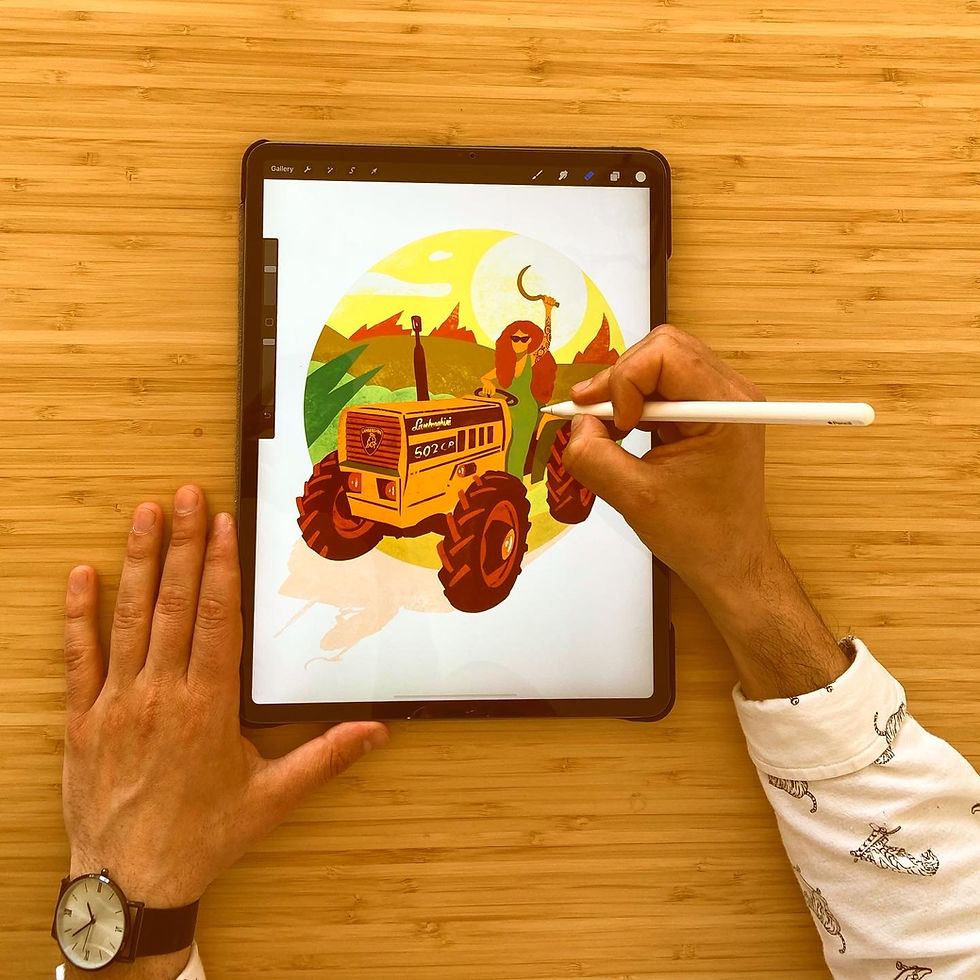
But then I am also painting acrylic, because sometimes I feel the need to get dirty you know, the iPad is just so clean and sometimes I feel like I am missing something, like the sensation of it. Like sometimes the iPad makes you feel like you're a designer and I want to feel like an artist.
I like to be able to hang my work on a wall, to have this private moment with myself. This is what makes me feel more alive in an artistic way.
What has been the most interesting or maybe even, the most rewarding project that you've done? Like, maybe a commission you did that was really special for you?
Hum, that’s difficult to say. In the last period, I did many commission works and I am working on something right now that is really important. It is one of the most important things I’ve done.
Basically, there is an association and they are doing five CDs, and they are mixing the traditional songs from Valencia with the new styles and I am doing the covers. They did a crowdfunding and they now have 50,000 euros for the whole project, they're gonna do an amazing thing. And they contacted me to do an important aspect of the project for them, which is the image for the CD covers.

That's amazing, and such a great way to give back to the community.
Yeah, I’m really excited about it.
We spoke about this earlier, but when people view your work, what do you hope that they feel when looking at it? What do you want them to take away from it?
The first thing I'm looking for, because we are living in this world of social media, so on Instagram for example, I want to show myself and my work in a dynamic way. I started to realise that on Instagram or any social media really, you are given like two seconds to be seen by the rest of the world. So I allow that to push me to make a big impact, you're going to see something from me that, you might be interested in or not, but at least you are going to pay attention for those one or two seconds.
Yeah, the thing with Instagram, I want to be an explosion in your face. For one second.
But yeah, it’s difficult because I try to be really simple because I like to be clear as a designer, and I want to express something and I want it to be really fast. I find it really difficult to express myself in words. I get confused. But even in Catalan, I don't find the right words. So maybe I have to say 10 words to express something that could be said in 1.
So as an artist how do you convey your values through your work? We've talked about your roots, your imagery. What do you want people to understand from your work?
Well, basically, without being too extreme about it, I use my words, my Catalan roots, I talk about my language that used to be illegal to speak, and I want to defend my culture through my art.

I'm trying to show my past. I'm trying to bring my culture to the present and into the future and inspire others to create. I think we are all enjoying the kind of complete community we have, and of course, dreaming of something better for us. In the end, I guess I can say that I’m doing politics in my work.
It's really beautiful to hear you speak without any filter, about your roots and your culture. I think it’s liberating for many, and brave. Identity should be a free flowing expression, to participate in your community, unapologetically.
Yes, it’s really important for me. All my life I have had problems with that. With speaking my language and connecting with my roots and now I'm trying to find that voice in my illustrations.
Absolutely, the past cannot be changed, but the future can be. Art can be that medium to reach people.
Yeah, because like this, I can show people colours, my ideas, and they're going to hear what I have to say and that is really important. I'm making my art, but you are an influencer somehow on social media, and maybe in the future, I know that [instagram] is going to die out eventually, and there is only going to be the artistic side. But at the moment, I can play with these cards.
I would like to influence people with these ideas.
So even if there is one person, one guy who’s 20 years old, and he shares the Illustration of the LGBTQIA+ flag because he thinks it's cool and it’s full of colours. Perfect!
Like this I'm doing my job. I'm doing politics. And you are sharing it because you think, wow, it’s full of colours. Great. I did it, and I did it well.
How affected are you by the illustration industry?
I have always felt different, I never wanted to listen to rules, and all of this brought me here, to be myself, and be independent and self made and taught. When I finished school I left to work with my dad in his studio, and after 5 years I saw that I was unhappy, because it was my dad’s studio, not mine, and I wanted to do graffiti, so I just started to do a lot of things that now, give me references that I took from my past and my background, and then I realised that I was already having a career and I didn’t even know it.
It was so spontaneous and now I am working as an illustrator. I had a lot of discipline once I knew what I wanted to do, but I had to be free to make my own designs and decisions on my own, to feel it, to be free to draw everyday to study by myself. So it’s not because I went to University to study this, like this, no one is going to become an illustrator. You need to be in the moment, you need to know that this is what you want to do. You aren’t even thinking like, am I going to make money doing this?
It's just that you are so convinced about it, and soon it becomes part of you and you feel different. And then you can’t stop because it's now part of you. You just need passion and discipline.
Does your environment affect the work you do? From living at home in Valencia, to living in Amsterdam, and now in Venice, how does your location influence your work?
Yeah, this is funny because, if I was in Valencia, I never would have done this, to work with and talk about my roots, I never would have seen things from this perspective. I never would have arrived at this point, and I would've been blind to the idea that I would eventually need to ask myself “who am I”?
I would’ve been there at home, having a simple life. I would’ve been happy there, under the sun, not asking too many questions. But then I moved to Amsterdam and I saw the rhythm of life, the people running and I wanted to be more international, and then I changed ideas about it many times.
There was no sun there, in a way I needed Amsterdam to understand where I am from. And now, in Venice, I was asking myself, how many times are you going to move, how many languages are you going to speak, all of these things affect me in a way that I appreciate my roots even more.
But not going back to my country to live gives me this sort of, platonic idea of it, that it is the best, from here I think of it that way, but I don’t want to go back and see that it’s not perfect. I prefer to be here, looking at it as this euphoric place, maybe one day I’ll retire there, but right now I think being here is better for me.
I can understand that you might not have had a reason to talk about it if you had never left.
Well I used to want to be where everything was happening, I used to have a poster of New York in my room, and now I just want to be by myself and I don’t want to go to parties or be really busy, I just want to be on an island [laughs] but I guess that change comes with age or maturity.
Ok last question, where do you see your art going in the future?
Well, some years ago I used to imagine things, if this were all a process, that my style is slowly, slowly becoming more solid, always using my roots, colours, forms, my thoughts and what I want to say, but eventually making it more minimalistic maybe, more visual or iconic and to see that on a canvas, in a gallery.
I don’t want to reach people having my art work in the living room, I want to show people that my work is something important. That I have been cooking this recipe for 20 years or something and now, this is the result. Let’s say I want to talk about myself and my roots but in a more minimalistic way eventually, so that I don't have to say so much, but I can say a lot at the same time, and people will know me and they will get it.
Right, giving you ways to evolve as an artist and keep recreating yourself, your image, and your work. Giving people new ways of understanding the same concept
Yes, I am going to continue no matter what, I am going to dedicate myself and my life to this, no matter what, even in the bad moments, it has always been there for me, since I was a child it was there, this is a relationship. Even if I have to work in a Pizzeria again, because I know that I am going to be happy to come home to that reality, of being an artist.
For the nearest future, I am going to continue in this way, illustrating, making CD covers, magazines, for artists in Valencia and Catalonia, because it's really the face of the culture, describing it, and the language, and reducing it to colours and figures. I think that's important work to be doing, and honestly, it makes me proud.

If you enjoyed this interview and would like to see more of Cesc, check him out and follow him on Instagram or visit his website for more art and news:
Cesc Roca Instagram:
Website:

Jasmine Melrose
Director & Founder of DECO the Blog
Jasmine Melrose is a Toronto native living in Amsterdam. Once a professional dancer, her passions include movement, fitness, yoga, healing, and all things vegan. Jasmine is a 500-hour trained yoga teacher, who loves to get you deeper into your practice. She is also a certified barre teacher who loves making raw vegan, guilt-free and good-for-you treats. Check out her recipes and articles on everything from fitness to yoga, to notes on a journey towards healing.


Comments